


 Getty Images
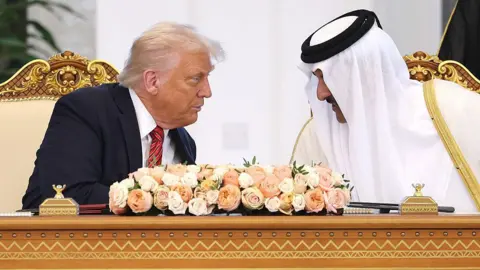
President Trump in recent days authorized an presidential directive vowing to employ every means - encompassing the American armed forces - to protect the Arabian peninsula country of Qatar.
The order declares that Washington will view any hostile action on the compact energy-rich nation as a risk to the United States itself and will "employ every legal and suitable action - such as statecraft, monetary, and as needed, defense - to safeguard the priorities of the United States and of the State of Qatar and to reestablish peace and stability".
The decree amounts to an unprecedented defense agreement between the US and a significant Middle Eastern partner, almost mirroring features of a North Atlantic Treaty Organization pact. It will be the admiration of its neighboring countries.
It's all the more significant considering how Qatar has shifted in just a few years from being the center of an financial and political embargo by its adjacent countries to now becoming the Middle East's diplomatic hub - lately in its capacity as intermediary between Tel Aviv and Hamas.
The Gaza-based group has its political offices in Doha and is at the moment examining Donald Trump's comprehensive Gaza peace proposal announced at the White House on at the beginning of the week. The Qatari capital is also home to the area's biggest American military installation, Al Udeid.
This decision to formalize American defense for Qatar is subsequent to the rage shown by the ruling Al Thani family in recent weeks after military attacks on their land targeted Palestinian officials, leaving numerous lower-level members of the organization deceased along with a local protection officer.
Qatar was also struck by Tehran previously in retaliation for United States military actions against its nuclear sites.
The state is at the core of increasing concern among Gulf Arab states that partnering with the United States and hosting its military bases is not affording them the protection they had presumed.
CCTV captures instant of aerial bombardment on group commanders in the Qatari capital
The nation's diplomatic corps positively welcomed the security decree saying it signified "a significant move in reinforcing the mutual tight military alliance".
But the President's action poses major concerns over its timing and motivation, and it is probable to be challenged in America's political center.
It establishes a standard impacting the fragile and combustible Middle East relations just as Gaza's ruling faction considers the President's plan for the future of Gaza.
Ex- US ambassador to Tel Aviv an experienced negotiator suggested Trump was giving Qatar an exceptional reward before seeming to get commitments from Qatar's leadership in exchange.
"Trump's security commitment to Qatar seems unreasonable unless they deliver a yes from the Palestinian group, or oust them if they refuse," stated Shapiro.
The Tel Aviv-based media a leading daily concluded what is expected to be the interpretation in Israel: "Donald Trump granted immunity to Palestinian officials when living in Qatar, despite Benjamin Netanyahu's admonition that they would not be safe wherever they go."
But regional specialists say Trump's guarantee is crucial to stabilize a anxious Middle East, disturbed by Israel's increasing use of force internationally alongside broader apprehensions about the reliability of the American protection in the Arabian Gulf.
Firas Maksad from the consulting firm remarked the President's action went "some way" to bolster confidence in Qatar and additional Arabian peninsula friends, stating that he anticipated the Kingdom to pursue a similar commitment. "I do think it's largely in the American benefit to ensure their cooperation," the expert told journalistic sources.
The scope of the protection commitment for Qatar is comprehensive, extending to American armed support in the situation it is assaulted. In that sense it is similar to the alliance's collective defense clause requiring a combined reaction for an armed attack against any one member.
But being released as an official decree from the American government, it circumvents the legislative branch, which under the defense legislation should be advised by the chief executive before deploying American troops.
That means the order might lack binding power and could possibly be altered or ditched under a future president. It is also expected to face scrutiny from political opponents in the House and Senate.
The decision is also being challenged by parts of his Maga support base who consider it at odds with his "America First" policy.
A political activist, an significant far-right campaigner associated with Donald Trump, indicated Qatar was rather a danger than friend to the US.
The supportive commentator a conservative voice stated the decree disrupted the US's conventional partnerships in the region, asking: "Should the command of Hamas in Qatar is targeted by Israel, are we going to war with the Jewish nation?"
Furthermore the matter of the President's relatives' private and commercial connections to Qatar, which his adversaries claim constitute a impropriety in his diplomatic engagements with the extremely rich Middle Eastern nation.
The Trump Organization, run by his sons the President's heirs, finalized a agreement in {April|spring|
